How to work out the volume of a cylinder is typically a grade 4 GCSE question..
GCSE Grade C question to calculate the volume of a cylinder with a radius of 3cm and a height of 4cm.
How to work out the volume of a can of coke. Just a quick video to calculate if 330ml is accurate. It is… but my estimation shows 380ml ! I’ve not allowed for the coke can design and not measured too accurately. Although I hope it helps to get an idea of working out the volume of a ‘real’ cylinder.
Try the Quick Test circles and cylinders
A cylinder can be any size but it must have a circular top and base.
They are used in many different ways from cake boxes to transporting fuel.
Examples of cylinders are oxygen, gas, flask, pipe, bin, vase, engine, cup, torch, computer hard drive, shock absorber, can of baked beans, packet of biscuits, lamp post and candle. Contact us with any more suggestions!
It could be very important to find out a volume –
- to avoid overfilling
- using too much material
- working out the cost
- calculating the flow, pressure, density, mass
- and so on…
The two measurements you will need to find are:
Height – usually given in the question – and area.
Make sure that the units are the same i.e. centimetres or metres.
Calculate the area of the circle first …. by using the formula
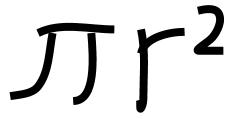
- this is pronounced as ‘pi r squared’
- pi is usually 3.142
- r is the radius of the circle
Note that ‘r squared’ means ‘radius x radius’ (NOT 2 x the radius!).
….. and then multiply by the height.
So, for a radius of 5cm and a height of 10 cm:
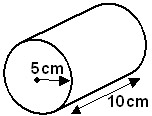
Area of circle is ‘pi r squared’
so pi x 5 x 5
which = 3.142 x 5 x 5
Therefore, area of end circle = 78.55 cm squared
Then multiply the area of the circle by the height of the cylinder –
= 78.55 x 10
Therefore, total volume of cylinder = 785.5 cm cubed
Watch the videos on YouTube:
https://www.youtube.com/watch?v=ENnFJXk67xk
https://www.youtube.com/watch?v=yeeWRYMxp_0
https://www.youtube.com/watch?v=r-6m6GLqK7E
https://www.youtube.com/watch?v=WddhEd9bk0o
Hi simon you are a great teacher but the flickering of light and the
constant focusing of your camera makes it difficult for me to concentrate
on your video’s.
Volume (3d) = Base Area (2d) * Height (golden word i was searching for !!)
Thanks Prof +Simon Deacon !!
One suggestion is, please tell them cm3 = milliliter (i.e) 1000 cm3 = 1
Liter, would be easy to understand the unit better that way.
Example: 113 cm3 = 113 ml
Why is it when you use different calculators (TI-30XS) when you use the Pi
button to set u the problem you get a different answer?
Thank you for helping me to understand how to fine the volume of a
cylinder.
Thank you so much.
you my friend are a maths prodigy thanks so much for all your help my exam
is next week Thursday i just want to say if i get a C grade its because of
your help so thank so much because i was always working at grade D and you
have help a lot lets hope i get the grade C in the exam
Thanks for your Calculation I was forget about this calculation .
I decided I will take down notes to my copy because these informations are
really usefull, thank you 😀
you forgot to times the top circle by 2 as theirs also the one on the
bottom meaning the answer is wrong
Simple and to the point. You, sir, know your stuff.
:]
Sir, can you do pythagoras
Thank you sir !!
Thats pretty cool. I am working on assignment to measure about 50 cans. I
have to agree that his have definitely made things much easier. Thanks
heaps!!!
Thank you so much, that was a good reminder.
where did the 113.112 from ?
thanks
i hope i do good with my studies with your support
thanks simon
ahhhhhh… hello simon i just want to know that how to find the high of a
cylinder ??? pllzzzz help me ..
Thank you so much, I have the CAHSEE in 2 days and I needed to study and I
forgot about how to calculate volume of a cylinder!
Hi Simon,
I actually just completed a lab very similar to this. Your approximation of
the soda can volume, (380 mL), is actually pretty close. There is a small
pocket of air within the can, which allows for a certain degree of error
during the filling process. This also makes unopened cans “almost”
positively buoyant. Thanks!
Was so very helpful! Thank you for uploading!!
OMG seriusly u are the best teacher ever I need u in my lessons of maths
thanq u very much..for shearing knowledge..
Hello Simon that was really a great help. Can you please do a tutorial for
finding volume of a metal hollow cylinder.
Love the drawing. This helped. Thanks so much!
Simon Deacon can you do a tutorial for some hard percentages like 23่
percent or something like that plz.i am having a hard time learning about
them thx.
Thank you, helped a lot
cylindrical area formula two types available one is 3.14 X r X r .another
one formula also (3.14 x D x D) / 4 are u know???????
you ripped of mr collins our colliun who art in hgeaven hallowed be thy
brackets ! >:(
Thanks this helped a lot 🙂
Thanks u r my maths hero never knew how to do until you did the questions
so I can understand thanks alot
A very good video.
A very good video.
Pi is not 3.142 its 3.14
Thank you so much 🙂
This video was very helpful ,
thanks helped out big time like all the details and exlpaning
Helped my kids alot
Youtube is much easier than reading… lol
really helped thanx
thx
Thank you Sir, This really helped me.
Hi Clara – thanks for the question. Probably the easiest is to calculate two cones, one with the thickness added, the other as the smaller cone. Then subtract one from the other. There’s a similar question (?) on How to calculate the volume of a hemisphere video. Is that OK? If not, please email through mathswrap and I’ll try to help. All best S
How do you work out the volume of a cylinder when it has a thickness for example…..
height-21cm
Diameter- 6.5
and an extra added thickness of 0.5??/
Hi – I manage 3 First Class Learning tutoring centres in North Leeds.